


Хората използват тръби от хиляди години. Може би първата употреба беше от древните земеделци, които отклониха водата от потоци и реки в своите полета. Археологическите данни сочат, че китайците са използвали тръстикова тръба за транспортиране на вода до желаните места още 2000 0010010 nbsp;B.C. & nbsp;Clay tubes that were used by other ancient civilizations have been discovered. During the first century & nbsp;A.D. & nbsp;, the first lead pipes were constructed in Europe. In tropical countries, bamboo tubes were used to transport water. Colonial Americans used wood for a similar purpose. In 1652, the first waterworks was made in Boston using hollow logs.
Development of the modern day welded steel pipe can be traced back to the early 1800s. In 1815, William Murdock invented a coal burning lamp system. To fit the entire city of London with these lights, Murdock joined together the barrels from discarded muskets. He used this continuous pipeline to transport the coal gas. When his lighting system proved successful a greater demand was created for long metal tubes. To produce enough tubes to meet this demand, a variety of inventors set to work on developing new pipe making processes.
An early notable method for producing metal tubes quickly and inexpensively was patented by James Russell in 1824. In his method, tubes were created by joining together opposite edges of a flat iron strip. The metal was first heated until it was malleable. Using a drop hammer, the edges folded together and welded. The pipe was finished by passing it through a groove and rolling mill.
Методът на Russell & не се използва дълго, защото през следващата година Comelius Whitehouse разработи по-добър метод за изработка на метални тръби. Този процес, наречен дупка - процес на заваряване, е основата на настоящите ни тръби -. По неговия метод тънки листове желязо се нагряват и изтеглят през конус - отвор. Докато металът мина през отвора, краищата му се извиха и създадоха форма на тръба. Двата края са заварени заедно, за да завършат тръбата. Първото предприятие за производство
this process in the United States was opened in 1832 in Philadelphia.
Gradually, improvements were made in the Whitehouse method. One of the most important innovations was introduced by John Moon in 1911. He suggested the continuous process method in which a manufacturing plant could produce pipe in an unending stream. He built machinery for this specific purpose and many pipe manufacturing facilities adopted it.
While the welded tube processes were being developed, a need for seamless metal pipes arouse. Seamless pipes are those which do not have a welded seam. They were first made by drilling a hole through the center of a solid cylinder. This method was developed during the late 1800s. These types of pipes were perfect for bicycle frames because they have thin walls, are lightweight but are strong. In 1895, the first plant to produce seamless tubes was built. As bicycle manufacturing gave way to auto manufacturing, seamless tubes were still needed for gasoline and oil lines. This demand was made even greater as larger oil deposits were found.
As early as 1840, ironworkers could already produce seamless tubes. In one method, a hole was drilled through a solid metal, round billet. The billet was then heated and drawn through a series of dies which elongated it to form a pipe. This method was inefficient because it was difficult to drill the hole in the center. This resulted in an uneven pipe with one side being thicker than the other. In 1888, an improved method was awarded a patent. In this process the solid billed was cast around a fireproof brick core. When it was cooled, the brick was removed leaving a hole in the middle. Since then new roller techniques have replaced these methods.
Дизайн
Има два вида стоманени тръби, едната е безшевна, а другата има единичен заварен шев по дължината си. И двете имат различни приложения. Безшевните тръби обикновено са с по-малко тегло и имат по-тънки стени. Използват се за велосипеди и транспортиране на течности. Шевните тръби са по-тежки и твърди. Имат по-добра консистенция и обикновено са по-прави. Използват се за неща като транспортиране на газ, електрически тръбопровод и водопровод. Обикновено те се използват в случаите, когато тръбата не е подложена на висока степен на стрес.
Certain pipe characteristics can be controlled during production. For example, the diameter of the pipe is often modified depending how it will be used. The diameter can range from tiny pipes used to make hypodermic needles, to large pipes used to transport gas throughout a city. The wall thickness of the pipe can also be controlled. Often the type of steel will also have an impact on pipe & #39;s the strength and flexibility. Other controllable characteristics include length, coating material, and end finish.
Сурови материали
Основната суровина в производството на тръби е стоманата. Стоманата е изградена предимно от желязо. Други метали, които могат да присъстват в сплавта, включват алуминий, манган, титан, волфрам, ванадий и цирконий. По време на производството понякога се използват някои довършителни материали. Например, може да бъде боя
използва се, ако тръбата е с покритие. Обикновено леко количество масло се полага върху стоманени тръби в края на производствената линия. Това помага да се защити тръбата. Въпреки че всъщност не е част от готовия продукт, сярна киселина се използва в един производствен етап за почистване на тръбата.
Производството
процес
Steel pipes are made by two different processes. The overall production method for both processes involves three steps. First, raw steel is converted into a more workable form. Next, the pipe is formed on a continuous or semicontinuous production line. Finally, the pipe is cut and modified to meet the customer & #39;s needs.
Производство на блокове
1 Разтопената стомана се получава чрез топене на желязна руда и кокс (въглерод - вещество, което се получава при нагряване на въглища при липса на въздух) в пещ, след което се отстранява по-голямата част от въглерода чрез взривяване на кислород в течността. След това разтопената стомана се излива в големи дебели - стенени железни форми, където се охлажда в блокове.
2 In order to form flat products such as plates and sheets, or long products such as bars and rods, ingots are shaped between large rollers under enormous pressure.
Произвежда цъфтеж и плочи
3 За да се получи цъфтеж, слитъка се прекарва през чифт набраздени стоманени ролки, които са подредени. Тези видове ролки се наричат & "; две - високи мелници. & "; В някои случаи се използват три ролки. Ролките са монтирани така, че каналите им съвпадат и те се движат в противоположни посоки. Това действие кара стоманата да се прецежда и разтяга на по-тънки, по-дълги парчета. Когато ролките се обърнат от човешкия оператор, стоманата се изтегля обратно, като я прави по-тънка и по-дълга. Този процес се повтаря, докато стоманата постигне желаната форма. По време на този процес машини, наречени манипулатори, преобръщат стоманата, така че всяка страна да се обработва равномерно.
4 Ingots may also be rolled into slabs in a process that is similar to the bloom making process. The steel is passed through a pair of stacked rollers which stretch it. However, there are also rollers mounted on the side to control the width of the slabs. When the steel acquires the desired shape, the uneven ends are cut off and the slabs or blooms are cut into shorter pieces.
Допълнително обработване
5 Blooms are typically processed further before they are made into pipes. Blooms are converted into billets by putting them through more rolling devices which make them longer and more narrow. The billets are cut by devices known as flying shears. These are a pair of synchronized shears that race along with the moving billet and cut it. This allows efficient cuts without stopping the manufacturing process. These billets are stacked and will eventually become seamless pipe.
6 Slabs are also reworked. To make them malleable, they are first heated to 2,200° F (1,204° C). This causes an oxide coating to form on the surface of the slab. This coating is broken off with a scale breaker and high pressure water spray. The slabs are then sent through a series of rollers on a hot mill and made into thin narrow strips of steel called skelp. This mill can be as long as a half mile. As the slabs pass through the rollers, they become thinner and longer. In the course of about three minutes a single slab can be converted from a 6 in (15.2 cm) thick piece of steel to a thin steel ribbon that can be a quarter mile long.
7 After stretching, the steel is pickled. This process involves running it through a series of tanks that contain sulfuric acid to clean the metal. To finish, it is rinsed with cold and hot water, dried and then rolled up on large spools and packaged for transport to a pipe making facility.
Изработка на тръби
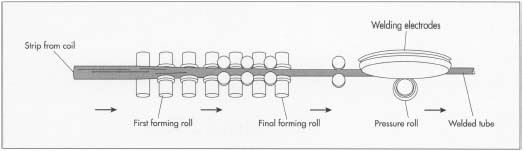
8 Both skelp and billets are used to make pipes. Skelp is made into welded pipe. It is first placed on an unwinding machine. As the spool of steel is unwound, it is heated. The steel is then passed through a series of grooved rollers. As it passes by, the rollers cause the edges of the skelp to curl together. This forms an unwelded pipe.
9 The steel next passes by welding electrodes. These devices seal the two ends of the pipe together. The welded seam is then passed through a high pressure roller which helps create a tight weld. The pipe is then cut to a desired length and stacked for further processing. Welded steel pipe is a continuous process and depending on the size of the pipe, it can be made as fast as 1,100 ft (335.3 m) per minute.
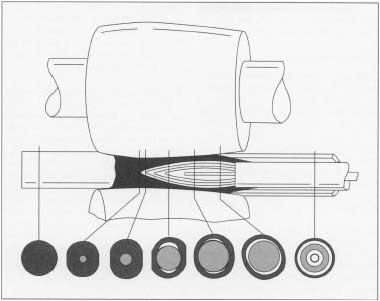
10 Когато е необходима безшевна тръба, квадратните заготовки се използват за производство. Те се нагряват и формоват, за да образуват цилиндрова форма, наричана още кръгла. След това кръгът се поставя в пещ, където се нагрява бяло - горещо. След това нагрятият кръг се навива с голямо налягане. Това търкаляне с високо налягане води до изпъване на заготовката и образуване на дупка в центъра. Тъй като този отвор е с неправилна форма, пробивна точка с форма на куршум се изтласква през средата на заготовката, докато се търкаля. След етапа на пробиване тръбата все още може да има неправилна дебелина и форма. За да се коригира това, той се предава през друга серия от валцови мелници.
Крайна обработка
11 After either type of pipe is made, they may be put through a straightening machine. They may also be fitted with joints so two or more pieces of pipe can be connected. The most common type of joint for pipes with smaller diameters is threading—tight grooves that are cut into the end of the pipe. The pipes are also sent through a measuring machine. This information along with other quality control data is automatically stenciled on the pipe. The pipe is then sprayed with a light coating of protective oil. Most pipe is typically treated to prevent it from rusting. This is done by galvanizing it or giving it a coating of zinc. Depending on the use of the pipe, other paints or coatings may be used.


